


Spam and scam calls have become a persistent and disruptive reality for U.S. consumers, eroding trust in voice communications and rendering traditional caller ID largely ineffective. Despite regulatory efforts and incremental improvements, consumers overwhelmingly lack confidence in the accuracy and legitimacy of caller ID information, with most refusing to answer calls from unknown numbers, even when caller ID is present.
This breakdown in trust is driven by the sheer volume of nuisance calls, increasingly sophisticated spoofing and impersonation tactics, and the failure of existing solutions to provide verified, trustworthy caller identity. As a result, consumers feel unprotected, vulnerable, and disengaged from the voice channel, often missing important or legitimate calls out of caution.
This trust deficit extends beyond consumers to the brands attempting to reach them. Industries such as financial services, telecom, and eCommerce are disproportionately associated with spam and scam activity in consumers’ minds, negatively impacting brand perception, engagement, and loyalty—even for legitimate businesses. While voice remains a valued communication channel, continued inaction risks accelerating consumer avoidance and further reputational damage. The core challenge is clear: without a trusted, verifiable caller ID framework that restores confidence in who is calling and why, both consumers and brands will continue to bear the cost of a broken calling experience.
This report — commissioned by Numeracle, and conducted by Coleman Parkes — is based on a survey of 2,020 U.S. consumers, and reveals the extent to which consumer trust and confidence in caller ID information has been impacted by repeated spam and scam calls. It investigates the influence of these calls on the perception of brands like you and examines the solutions to remediate an issues that has neglected consumer trust and exposed people to unnecessary, and avoidable, risks.
The path to restoring trust in voice communications lies in establishing trusted, verifiable caller identity as a foundational element of every call. Rather than relying on reactive, consumer-managed tools like device-level blocking, which are indiscriminate and contribute to missed legitimate calls, the industry must move upstream to authenticate and govern caller identity itself. This requires coordinated action across brands, service providers, and regulatory bodies to ensure that accurate, verified caller information is consistently delivered and displayed at the point of call.
Numeracle’s Secure Verified Identity Presentation (sVIP) is a solution that operationalizes trusted caller ID at scale by extending and enabling CTIA’s Branded Calling ID (BCID)™ framework. Built on strong governance, rigorous vetting, and identity assurance, sVIP activates verified branded calling with clear accountability across the ecosystem. This collaborative model removes the burden from consumers, restricts access for bad actors, and provides a standardized, enforceable way for legitimate brands to authenticate who they are and why they are calling, the moment a call is received.
When trusted, verified caller ID is implemented, consumer behavior shifts measurably. Research shows that enhanced caller information, such as verified branding or logos, directly increases trust and engagement, with nearly half of consumers more likely to answer or engage with a legitimate call. This renewed confidence reduces call avoidance, minimizes missed important calls, and helps reverse the negative brand associations created by years of nuisance calling.
- 21% of U.S. consumers reported that enhanced caller ID information, such as a logo on an incoming call, would increase their trust in a legitimate brand.
At the same time, verified caller identity weakens the effectiveness of spoofing and impersonation, depriving scammers of the anonymity they rely on. For brands, this translates into stronger reputation, improved customer engagement, and preserved loyalty.
- 45% of U.S. consumers report that verifiable caller ID would increase their likelihood of engaging with a brand.
Executive Summary
Spam and scam calls have become a tedious part of U.S. consumers’ lives. Most are bothered by nuisance calls on a daily or weekly basis, and the solutions in place today fail to properly solve the issue. Despite progress to better equip consumers with the right information when faced with an unrecognized number, existing caller ID information falls short of providing the level of trust and the degree of legitimacy that will restore confidence in the minds of consumers.
This lack of verified, trusted caller ID is having a significant impact on the lives of American citizens and on the brands that engage with them. Most consider financial services, telecom providers, and eCommerce businesses are perceived as the common culprits behind most nuisance calls. This is impacting how likely they are to engage with a brand, and even, their loyalty towards them.
The reality today is that consumer trust in caller ID information is non-existent. Consumers want, and need, more to be done to provide them with verified, legitimate, and trustworthy caller information.
A solution that places trust at the heart of the conversation is urgently needed. One that will provide the right level of information so that the 66% of consumers who admit that more accurate caller information would encourage them to answer unrecognized numbers, can do so knowing that the displayed caller ID is true and accurate. Failure to do so will see consumer trust further eroded while nefarious attacks on consumers by scammers continue.
Methodology
- Numeracle commissioned Coleman Parkes to conduct this research
- The survey was conducted among 2,020 consumers who have received a spam or scam call on their phone
- The online survey was conducted in May 2024
Definitions
These definitions were provided to guide respondents completing the survey:
Spam Call
An unsolicited phone call that attempts to promote a product, service, or ideal to you where you haven't given permission to be contacted. This includes robocalls: an unwanted automated phone call that delivers a prerecorded message.
Scam Call
An illegal, unsolicited call that aims to defraud the recipient and steal personal and/or financial information. The caller may, for example, impersonate a brand or individual you trust.
Caller ID
The information displayed by an incoming call.
Foreword
“Having traveled the world to create space for innovators building infrastructures and solutions in digital identity to meet and collaborate for almost two decades, I still find myself in awe of some of the most horrendous identity problems.
Rebekah Johnson, Numeracle’s CEO, was one of the passionate entrepreneurs who showed up at the Internet Identity Workshop, a user-centric identity forum I co-founded 19 years ago and still co-organize today. Rebekah lit the room up with an exuberant introduction to her work on identity in the phone system with her decades of deep experience in the telecommunications industry.
In my mind, we have “identity” in the phone system. After all, we get “caller IDs,” our real-world identities that are associated with our phone numbers. It is not new that caller IDs, like many of our other identities, could be spoofed. But Rebekah really brought it home when she shared the story of our veterans, who once put their lives on the line for our country and need and deserve to be taken good care of after they complete their service. However, veterans in the U.S. are facing serious challenges getting care because the Veteran Administration is not able to connect to them effectively - their outgoing calls to veterans are being labeled as “spam.” This is due to the current way that caller IDs are managed in the bowels of the phone system.
The problem of ‘spam calls' is also a problem of ‘unreceived legitimate calls — labeled spam'. With the variety of communication channels we have today, voice is still the primary channel for important life matters. We can’t afford to not have trusted and secure identities (caller IDs) in such a critical channel.”
— Kaliya Young; Identity Woman
Introduction
Consumers in the U.S. have become all too familiar with the unpleasant experience of picking up the phone to yet another nuisance spam or scam call.
For many Americans, this is an almost daily occurrence, and an issue compounded by the prevalence of illegal robocalling and attempts from scammers to defraud the public by impersonating trusted brands and individuals.
- How likely are you to answer a phone call from an unrecognized phone number?
- Have you missed, ignored or declined an important or wanted call due to a lack of trusted caller information?
- When it comes to preventing spam or scam calls, which entity is responsible for offering a solution?
Fortunately, the problem isn't flying under the radar. In fact, it's an issue that's been spoken about countless times in the media, in regulatory settings, on social platforms, and among the general public.
And yet, little is being done to safeguard consumers against these annoying at best, and nefarious at worst, interruptions to their daily lives. The number of spam or scam calls isn't decreasing, and scammers are only getting more sophisticated in their attempts to extricate confidential information from innocent consumers.
This pervasive problem has led to a widespread lack of trust and a heightened sense of vulnerability. A staggering 76% of U.S. consumers have expressed their reluctance to answer calls from unknown numbers, and a further 74% have reported receiving calls from untrustworthy sources. The prevalence of spam and scam calls has reached such a level that no one can be certain of the true identity of the caller on the other end of the line.
Despite efforts to provide more trusted information via caller ID, consumers lack confidence in the accuracy of the information given. This begs the question: How can trust be restored in consumers' minds when it comes to caller ID information? How can they be assured that they won't pick up the wrong phone call or miss important calls for fear of being on the receiving end of a spam or scam call?
This report, commissioned by Numeracle and conducted by Coleman Parkes, is based on a survey of 2,020 U.S. consumers. It reveals the profound impact of spam and scam calls on consumer trust and confidence in caller ID information. The report delves into the influence of these calls on brand perception and explores potential solutions to restore consumer trust and mitigate the risks posed by these calls.
Little Respite from Nuisance Calls
While spam and scam calls are a known entity, when examined closely, their frequency is staggering.
For 77% of U.S. consumers, spam or scam calls are a daily or weekly occurrence. In fact, nearly half say they receive at least one spam call per day, and over one-third receive at least one per week. (Figure 1).

Thankfully, while the levels of nuisance calls are high, consumers are savvy to warning signs of fraud, and the number of U.S. consumers who have fallen victim to fraudulent scam calls is relatively low at just 15%. Of those, inaccurate caller ID was the most common reason (43%) for initially answering an unrecognized number, with the information provided leading them to believe the call was from a trusted person or company. This highlights the vulnerable state consumers find themselves in today.
Despite the Federal Communications Commission (FCC) 's efforts to combat spoofed caller ID through initiatives such as STIR/SHAKEN, more needs to be done to ensure that the caller ID information delivered to consumers is accurate. Inaction and the inefficacy of existing solutions are leaving consumers exposed to bad actors and contributing to their distrust of caller ID methods.
More needs to be done as less than 1 in 10 Americans feel adequately protected from frequent scam or spam calls.
This frustration regarding nuisance calls is aggravated by the fact that the vast majority, 91%, of U.S. consumers believe that more could be done to protect them from the relentless pursuit of spammers and scammers. Even more worryingly, 30%—close to a third—do not feel they are protected at all from spam or scam calls (Figure 2).
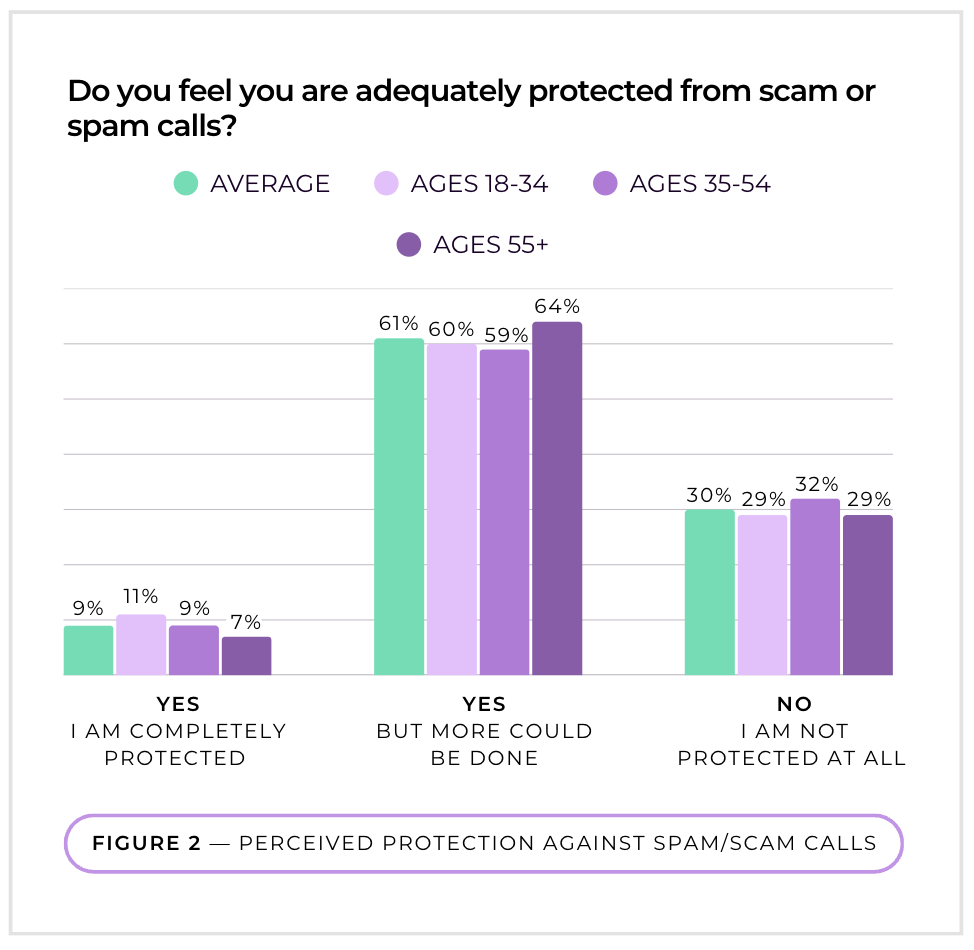
If consumers continue to feel as though they are not protected, or that not enough is being done to prevent nuisance calls, they’ll start to disengage with the voice channel as a primary communication method. This is particularly alarming for brands who use calls as a channel to reach consumers.
Fortunately, there is still time and opportunity to turn perceptions around — over half of consumers (58%) still trust phone calls about the same as they do other communications channels.
If brands, service providers, and regulatory bodies can come together to deliver the right solution that puts consumer trust at the heart of the calling experience, voice calls will continue to be an important touchpoint.
An Absence of Trust Undermines Consumer Confidence
It’s clear from the data already presented that the presence of sophisticated spoofing and impersonation scams, coupled with the sheer volume of spam calls, has undoubtedly influenced consumer behavior.
Their time is being wasted, and their patience tested. Not only that, but consumers are also missing out on what could be important conversations. 69% of our respondents said that they have missed, ignored, or declined an important or wanted call due to a lack of trusted caller ID information—a frustrating challenge in a world where responsiveness is more critical than ever.
It's clear there are very real shortcomings with existing caller ID information. 66% of U.S. consumers said they would not answer a call even if caller ID was present. Unfortunately, caller ID often fails to establish the legitimacy of a caller, despite the information provided. In fact, 85% said that they rarely or never trust caller ID for an unrecognized number (Figure 3).

The issue of trust is deeply ingrained in consumer perceptions of the value of caller ID. Consumers not only perceive caller ID information to be inaccurate, but they also lack trust in the information it provides. This is particularly crucial because in this context, accuracy and trust are inseparable; the less accurate the information, the less trustworthy consumers perceive the caller ID information to be.
While this pattern may seem logical, it’s important to note that improving accuracy may not always increase trust, and vice versa. For example, some consumers may trust an organization or solution despite it being only semi-accurate, while others may never trust an organization or solution that is entirely 100% accurate.
Trust is a complicated human emotion and can be difficult to change. However, in this context, greater accuracy of caller ID information will undoubtedly impact consumers’ perception of its value. It’s therefore imperative that the industry move towards a solution that eliminates what exists in the market in order to restore and strengthen consumer trust.
Harming Brand Affinity & Industry Reputations
As consumer trust in caller ID information crumbles, this reality puts brands in a difficult position. This is especially true for the sectors consumers most commonly associate with spam and scam calls. According to respondents, consumers perceive that they are most likely to receive a spam or scam call from Financial Services companies, followed by telecom providers, and eCommerce businesses.
Interestingly, among respondents aged 55+, there is greater skepticism towards eCommerce, home improvement, and travel and leisure (Figure 4).

While these industries may not be the most prolific culprits behind nuisance calls, these connotations in the minds of U.S. consumers can damage brand identity for any business in these sectors. For 69% of consumers, their perceptions of brands in the verticals most associated with spam and scam calls have been somewhat or significantly negatively impacted (Figure 5).

Worryingly, nuisance calls also negatively impact consumers’ perception of their favorite brands — 31% stated that nuisance calls would decrease their loyalty to those companies. The same amount would reconsider spending with them, and over a quarter would lose trust in their favorite brands (Figure 6).

When we consider that the majority of consumers today still value voice in the same way they do other communications channels, it’s clear that a solution needs to be made available before it’s too late. So what’s the answer to this caller ID and brand perception conundrum? It’s simple—trusted, verifiable caller ID.
By making trustworthy, verified information the heart of all calls, brands can overturn negative perceptions impacted by nuisance calls. Consumers are more likely to believe in the legitimacy of the information provided to them. In fact, we asked respondents how comprehensive, trusted caller information would impact their behavior—for 21% of consumers, enhanced caller ID information, or a logo on an incoming call, would increase their trust in a legitimate brand. Nearly half (45%) said it would increase their likelihood of engaging with a brand.
This is an important point—if nuisance calls are negatively impacting consumer engagement with certain brands, bottom lines will suffer, especially when we consider how quickly consumer trust can be eroded, and how slow it can be to regain it.
Solving the Caller ID Conundrum
With significant potential to impact brand identity, loyalty, and reputation, and with consumer trust in dire need of remediation, who is deemed responsible for solving this caller ID problem?
According to the findings, 57% of respondents believe that the mobile operator or telecom service provider should handle the responsibility of filtering and blocking nuisance calls. For respondents over the age of 55, the majority lean towards regulatory bodies such as the FCC or Federal Trade Commission (FTC) as those responsible for enforcing new rules and laws that protect consumers. It's worth noting that an overwhelming majority (90%) believe the issue to be solvable, underscoring the urgent need for a solution.
If brands and service providers do not act with urgency, it will likely negatively contribute to consumer perceptions that their best interests are not being considered. Despite responsibility being largely attributed to service providers, only a fifth of consumers use a method to block nuisance calls via their provider. When asked how consumers deal with spam or scam calls, 44% are blocking spam or scam calls within device settings (Figure 7).

While on-device solutions are a sensible option, it does little to fix the problem of missing wanted and expected calls, as device system settings are typically indiscriminate, and block any and all unrecognized numbers.
What’s more, this option also indirectly places the responsibility of dealing with unwanted calls on the consumer. In turn, this creates friction regarding how they perceive spam and scam calls and, coincidentally, how they view and value caller ID. If a device labels a call as spam or scam, or blocks a call automatically, they are more likely to trust this process, than they are a caller ID label that identifies a call coming from a specific organization.
While it’s clear that more needs to be urgently done to remove the responsibility of dealing with nuisance calls from the consumer, the good news is that consumers have hope for a solution to remediate the problem. And better still, there is a willingness to do so. Three-quarters of U.S. consumers would consider taking further action against spam and scam calls. However, only 16% would be happy to pay for a solution.

So, it’s clear from the data above that the current approach to preventing scam or spam calls is really just a band-aid, rather than a cure. Consumers feel that a solution is possible, but not enough is currently done to weaken the access that spammers and scammers have to them. Most importantly, not enough is being done to provide a solution that does away with consumer distrust of caller ID and restores consumers’ faith in the labeling information displayed on their devices.
Urgent Action Requires a Smart Solution
Unrecognized numbers have become synonymous with untrustworthy calls. For consumers in the U.S., the prevailing view is that the current caller ID system falls short of providing a reliable caller identity, leading to a decline in trust. This raises the question: how can we restore confidence in caller identity?
The only way is through trusted, verified caller ID.
For over two-thirds of consumers, this type of solution would reestablish confidence and enhance the likelihood that they would engage with an unrecognized incoming call.
And while consumers have different ideas about who is responsible for fixing the issue, the responsibility doesn’t need to fall to just one entity. In fact, it cannot—collaboration to find a solution to trusted caller ID is the direction that brands, service providers and regulatory bodies need to align on. They must work together to find and deploy a solution that upholds consumers’ best interests and protects the perception of brands among their customers.
At the heart of solving the trusted caller ID issue and bridging the gap between brands, service providers, and regulatory bodies is Numeracle. It's not just a solution, but an elegant one that provides sound governance for vetting, protecting, and enhancing trusted brand caller identity. Numeracle's unique role is in collaborating with its partner ecosystem to demonstrate STIR/SHAKEN’s existing frameworks’ ability to be utilized for a new purpose.
Numeracle doesn't just help, it empowers brands, service providers, and industry bodies to take identity verification a step further. It provides actual delivery and display of the identity behind the call, making verified branded calling a reality. This is an opportunity for brands to strengthen their position in a way that current branded calling solutions on the market cannot provide.
Today, we find ourselves in front of a real opportunity to make voice calls one of, if not the most trusted communications channel that consumers engage with brands through. Trusted, verifiable caller ID will see spammers and scammers deprived of their ability to catch out unwitting consumers and will end days and weeks of wasted time picking up the phone to unknown callers.
The time for branded caller ID is now, and brands, service providers, and regulatory bodies must do their utmost to put trust at the heart of the conversation.