


The telecom ecosystem and its associated regulations are changing at an unprecedented rate, and non-profit fundraising has not been exempt from the negative consequences of these changes. Efforts to protect wireless subscribers from unwanted calls across the wireless carrier network have negatively impacted fundraising efforts, causing a lack of trust in incoming calls from unknown or spam-labeled phone numbers, disrupting nonprofits’ goal completion.
By establishing an organization as a Verified Identity for the purpose of legitimate business purposes across the wireless calling ecosystem, and registering phone numbers to this Verified Identity, an organization can protect the reputation of its calls from improper classification as Spam or Fraud, thus increasing the likelihood of the calls being trusted, answered, and converted to successful goal completion.
If similar increases in completion rate achieved within this case study were achieved across additional clients, estimating 1,800 total additional call completions across total client count, at $3 generated per completion, an additional $5,400 per day in revenue would be generated. This can be projected to achieve an additional $29,700 per week and $1,544,400 increased revenue per year, all without an increase in agent hours or agent talent.
Overview: About this Case Study
The telephone has long been a very effective tool in direct marketing fundraising. Even in today’s increasingly digital world, a one-on-one conversation with a donor can be an emotionally powerful way to communicate for non-profit organizations.
The purpose of this case study is to determine how calls originating from a Verified Identity dialing outbound on registered phone numbers perform when compared to calls originating from an unknown source using unregistered or unidentified phone numbers.

Approach
- Evaluate outbound calling activity over a period of 10 days
- Evaluate 200K+ total mobile outbound dials as a survey size
- Measure KPIs on calls placed to all major wireless cellular network subscribers
Caller Profile & Setup
The calling entity featured in this case study is a large international relief and development agency that focuses on helping children. Dialing for this organization is managed by MDS Communications, one of the nation’s largest telephone fundraising providers.
KPIs Measured
- Connect Rates: Do live connect rates increase?
- Completion Rates: If the connect rates increase, does this translate to increase completion rates?
- Gift Rates: If donors trust who is calling, are they more likely to pledge a gift
The Challenge
The telecom ecosystem and its associated regulations are changing at an unprecedented rate, and non-profit fundraising has not been exempt from the negative consequences of these changes. Efforts to protect wireless subscribers from unwanted calls across the wireless carrier network have negatively impacted fundraising efforts, causing a lack of trust in incoming calls from unknown or spam-labeled phone numbers, disrupting nonprofits’ goal completion.
The Solution: Verified Identity & Number Reputation Management
By establishing an organization as a Verified Identity for the purpose of legitimate business purposes across the wireless calling ecosystem, and registering phone numbers to this Verified Identity, an organization can protect the reputation of its calls from improper classification as Spam or Fraud, thus increasing the likelihood of the calls being trusted, answered, and converted to successful goal completion.
The Results: Business Case for Identity Verification & Phone Number Registration
Based on the success of the single calling entity featured in this case study analysis, MDS structured projections to determine how the completion of Identity Verification and Phone Number Registration across a wider cross-section of its supported client base may translate into additional revenue for the business.
If similar increases in completion rate achieved within this case study were achieved across additional clients, estimating 1,800 total additional call completions across total client count, at $3 generated per completion, an additional $5,400 per day in revenue would be generated. This can be projected to achieve an additional $29,700 per week and $1,544,400 increased revenue per year, all without an increase in agent hours or agent talent.
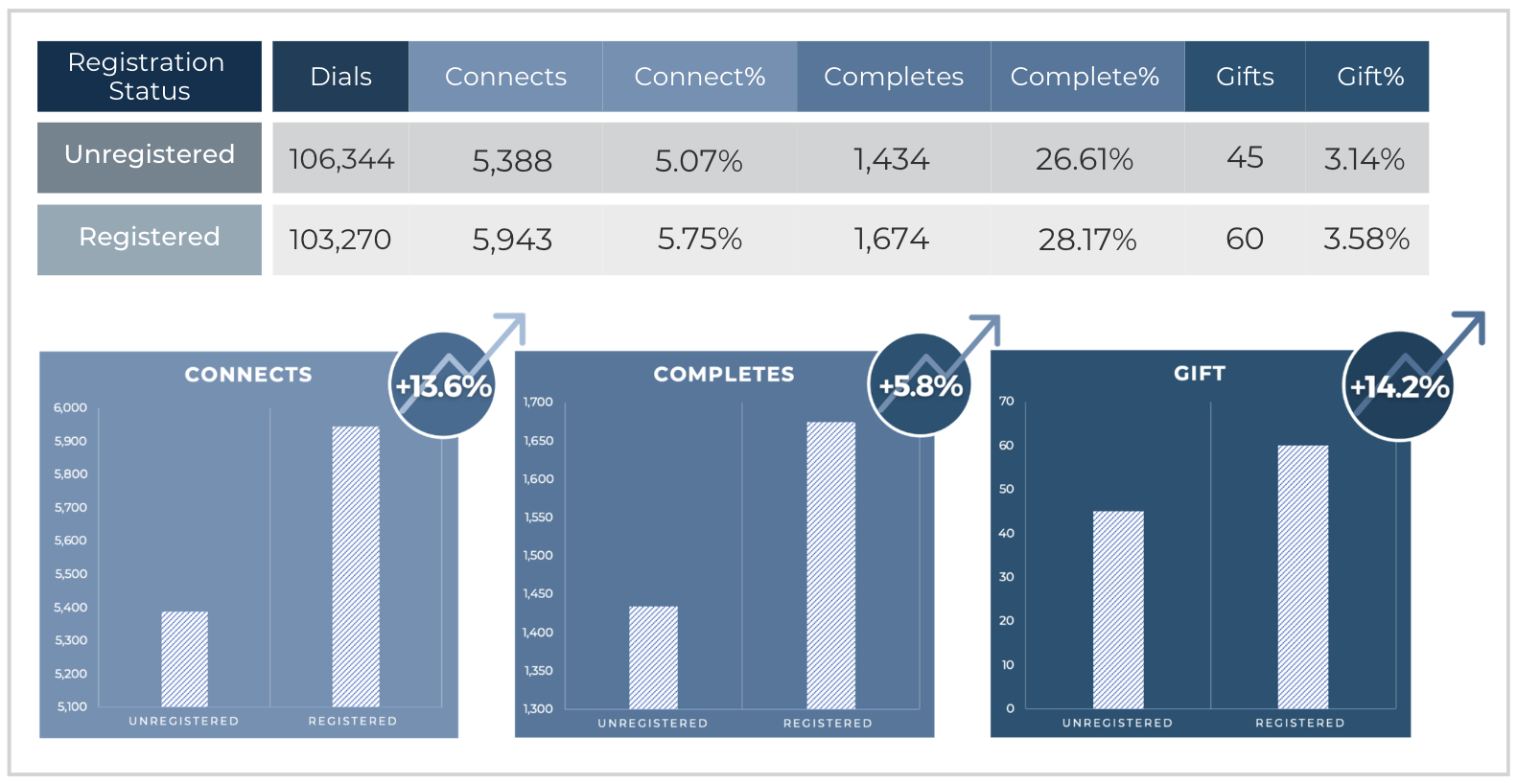
Why This Matters: Projected Business Impact Achieved
$1,544,400 increased revenue per year without an increase in agent hours or agent talent*
*assuming comparable improvements to connect, complete, and gift rates measured within this evaluation period as achieved by the featured calling entity managed by MDS for the purpose of this case study.
Conclusion
Through their partnership with Numeracle, MDS demonstrates how strategic identity verification and phone number registration can safeguard outbound fundraising efforts, protect number reputation, and drive higher connect, completion, and donation rates.