


Legitimate business calls are increasingly mislabeled as Spam, Scam, or Fraud due to carrier analytics, reducing answer rates, damaging brand trust, and disrupting critical customer communications across industries.
Numeracle enables enterprises to proactively manage and remediate phone number reputation through its Entity Identity Management™ platform, providing verified identity, visibility into labeling, and direct remediation across carrier analytics ecosystems.
Businesses that actively manage call reputation can improve contact rates, restore customer trust, and prevent revenue loss by reducing improper call blocking and labeling across carrier networks.
Executive Summary: About this Whitepaper
Have you ever received an incoming call labeled as ‘Spam’ or ‘Scam’? Do you know if your business calls are being displayed that way to your customers? Numeracle released this white paper to build awareness of how call labeling impacts legitimate enterprise communications and to outline strategies for addressing this growing problem.
Many factors can negatively impact phone number reputation, causing legitimate business calls to be mislabeled with warning tags such as Spam, Scam, Scam Likely, or Fraud. These labels directly affect call delivery, reduce answer rates, and erode customer trust, regardless of the intent or compliance of the calling organization.
Negative reputation starts calls off on the wrong foot. Improper blocking and labeling create friction before a conversation even begins, making it harder for businesses across healthcare, financial services, automotive, retail, public safety, and other industries to reliably connect with the customers they serve.
This white paper provides insight into how call labeling continues to impact call delivery today and explains why legitimate calls are being flagged. It also outlines practical strategies businesses can use to prevent improper blocking and labeling before customer communications and brand credibility are impacted.
State of the Industry: Call Labeling, Blocking, and Regulatory Response
Call blocking and labeling technologies were introduced in 2017 to address the problem of a growing number of illegal calls defrauding consumers. These technologies assign a reputation to calls, displaying labels such as ‘Scam,’ ‘Fraud’ or ‘Spam’ on an incoming call screen. Calls categorized as Scam or Fraud can also be blocked at the network level, based on this reputational scoring.
As illegal robocall traffic continued to grow despite call blocking and labeling technologies, increased legislative efforts such as the TRACED Act were signed into law. Implementation of the STIR/SHAKEN caller ID authentication framework across the carrier network was mandated by June 2020 as the result.
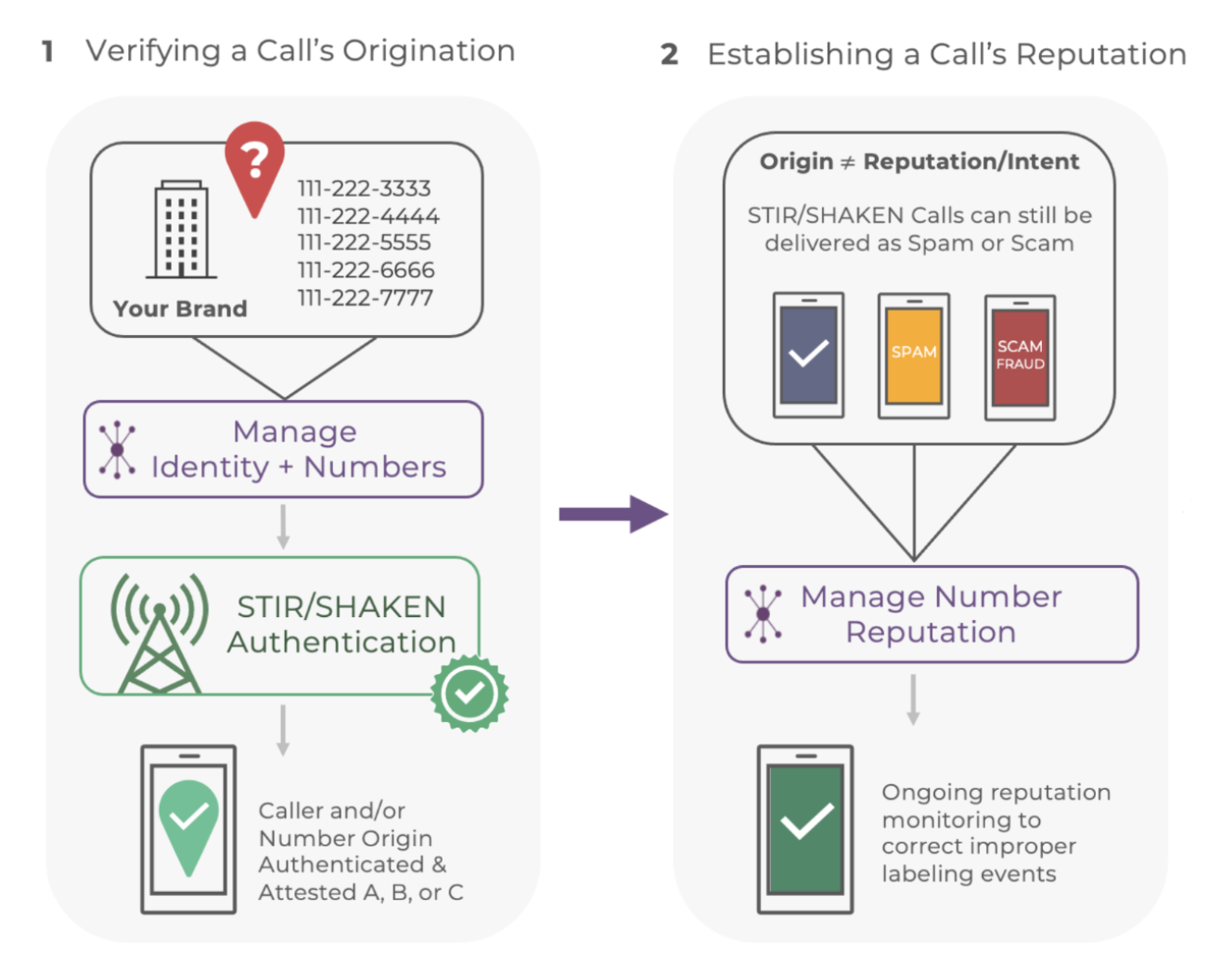
Now that STIR/SHAKEN is in its implementation phases, reasonable analytics are still utilized across the wireless carriers to guide decisions on call labeling. STIR/SHAKEN, in contrast, is utilized to verify the identity of the calling party and its authorization to deliver traffic across the phone numbers displayed. The purpose of STIR/SHAKEN is to reduce the number of illegally spoofed calls, but STIR/SHAKEN does not weigh in, in any way, on a call’s reputation.
2017
Call blocking and labeling technologies are introduced to address the problem of illegal calls defrauding consumers. These technologies assign a reputation to calls, displaying labels such as Spam, Scam, or Fraud on incoming call screens.
2018
Numeracle gets involved as the voice of the enterprise, protecting legal and wanted calls by remediating blocking and labeling issues through our Verified Identity and Number Reputation solutions in our EIM platform.
2020
Illegal robocall traffic continues to grow and begins to mislabel legal communications. The FCC publishes the TRACED Act, requiring implementation of STIR/SHAKEN to verifying the identity of the caller.
2021
FCC mandates two deadlines to implement the STIR/SHAKEN caller ID authentication framework across the carrier network, tracking progress or intent to file in the Robocall Mitigation Database. The second deadline was a deadline to hereafter mark the beginning of widespread call blocking.
2022-2023
The FCC published a series of Notice for Proposed Rulemakings and Requests for Comments in the matter of solving illegal robocalls. Numeracle’s proposals for Know Your Customer policies earns praise at the Senate as a solution for protecting against the harm caused by illegal robocallers.
STIR/SHAKEN: Is It Related?
Call Authentication vs. Reputational Analytics
STIR/SHAKEN is a framework used to verify the authorized use of a phone number in conjunction with a brand’s identity. The purpose is to provide a verified indicator (such as a green checkmark) to identify that an incoming call is from a business authorized to use that number, as opposed to a bad actor who is illegally spoofing a phone number they don’t have authorization to use or display.
The term “attestation” in reference to STIR/SHAKEN refers to the level of certainty (defined in levels A, B, or C) the service provider has in regards to the ownership or authorized use of the number being displayed in conjunction with the business’s identity.
Full Attestation (A):
Known customer using known number
Partial Attestation (B):
Known customer, unknown number
Gateway Attestation (C)
Unknown customer or number
These levels don’t guarantee call approval. Carriers and analytics engines may still flag or block suspicious calls regardless of attestation level.
While STIR/SHAKEN validates the call’s origination from an authorized source, it does not weigh in on whether or not you may want to answer the call. That’s where reputational analytics come back into play.
Reputational analytics utilize a separate technology than STIR/SHAKEN and display labels such as Scam or Spam as a call terminates on a called party’s mobile device, whether it’s been STIR/ SHAKEN attested or not. Being STIR/SHAKEN compliant does not have any impact to calls labeled as Scam or Spam. To address this, the reputation of the calls must be addressed within the analytics layer.
Analytics: The Scoring Behind the Label
If you have ever received a call on your cell phone labeled ‘Fraud,’ ‘Scam,’ or ‘Spam,’ you’ve experienced call labeling technologies in action. This scoring allows them to determine what to do in terms of call treatment (block, label, or redirect) when presented with robocalls that involve telephone numbers that have previously received algorithmic treatment.
The algorithms driving these reputational analytics will vary across mobile networks, but as a general rule of thumb, risk ratings, as described for the purposes of this white paper, can be defined as the raw perception data driving the presentation of the call labels themselves. A higher ‘risk’ rating drives more severe ‘warning’ language as presented to the consumer in the form of a call label. Risk ratings can also result in calls being blocked at the network level.
This is not the result of the STIR/SHAKEN framework, this is the result of a call’s negative reputation leading to its blocking or diversion to voicemail. Call labeling and blocking is available for free across all of the major wireless carrier networks, so anyone you’re calling on those networks could be at risk of seeing a negative label on your incoming call.
Call blocking or filtering apps, depending on consumer preference, can be configured to present a wide range of available data associated with a phone number including geographical information, suggested calling party name, etc. Apps represent a small percentage of the contact rate depreciation problem for businesses, thus, tackling this problem at the carrier level is the first recommended priority.
As reputational analytics remain in place as the primary determining factor to call presentation today, it’s imperative to establish visibility into the reputation of your phone numbers and take steps to remove the roadblocks of improper call blocking and labeling in order to protect your brand identity and retain the trust of your consumers moving forward.
Industry Impact & Insights
Identifying Phone Numbers at Risk for Improper Call Blocking & Labeling
Call labeling technologies at the wireless carrier-level lead to calls delivered as ‘Spam’ and ‘Scam’ and cause a lack of customer trust in your calls and damage to your brand reputation. Regardless of whether or not your carrier is STIR/SHAKEN compliant, your calls can still be blocked based on negative reputation.
Based on Numeracle’s analysis of phone numbers in use across multiple calling industries, we’ve identified an average of 25% of a business’s phone numbers are typically at risk for improper call labeling. This percentage can increase depending on the intent of the call, frequency of outbound dialing attempts, etc.
25% of a business’s phone numbers are typically at risk for being blocked or mislabeled, resulting in lost business, productivity, and customer satisfaction equal to a financial loss of millions.
Even though STIR/SHAKEN has been deployed, the reputational analytics will still remain. As such, the best first course of action for businesses conducting outbound calling is to identify yourself to the analytics ecosystem as a Verified business, and identify your phone numbers as associated with a legitimate business purpose. Through this process, you’re able to remove the roadblocks of improper call blocking and labeling, protect your brand, correct ‘Scam’ or ‘Spam’ labeling, manage ongoing risk, and continue to reach your customers.
Reputation Remediation VS Monitoring
Ongoing remediation helps maintain healthy number reputation, can increase contact rates, improve your overall call delivery and brand reputation, and provide you with the necessary insight to structure successful calling campaigns.
As opposed to reputation monitoring-only solutions which give you access to the status of your phone numbers' labeling without a methodology to correct or remove the label across wireless carrier networks, Numeracle offers the only end-to-end identity management solution that provides you with the control and consistency you need to define how your calls are displayed across the wireless calling ecosystem with complete visibility into remediation status and history of numbers previously labeled Spam, Scam or Fraud.
Recommendations
Consider Call Volumes
As your business works to assess the impact of improper call labeling on your contact rates, you will need to understand the relationship between phone number risk and phone number usage. For example, if 99% of an organization’s call traffic is delivered across one number, and you’re dialing out on this phone number like crazy, auto-dialer or not, you’re likely to experience some challenges with labeling. The algorithms are subjective, and ‘aggressive-looking’ dialing can be enough to trip the threshold.
Call Intent
Using one phone number to make a variety of different types of phone calls can come off as ‘confusing’ and ‘inconsistent’ to the reputational analytics. It can also result in an increase in potential mislabeling associated with your phone numbers.
Think of this as a case of ‘multiple personalities.’ To the call labeling analytics community, if one number is originally recorded as calling about ‘new account set-up for Company A’ then tomorrow it’s calling about ‘customer service for Company B,’ and the next day, ‘past-due payments for Company C,’ this perceived lack of clarity and consistency can seem suspicious and negatively affect a number’s reputation.

Stay Consistent
It’s a symptom of today’s calling ecosystem, but due to the increase in illegal robocall traffic, reputational analytics can sometimes perceive abrupt changes to calling patterns, sudden spikes in traffic, and the frequent swapping of phone numbers as ‘fraudulent-looking behaviors.’
When the behaviors used by legal call originators too closely resemble the preferred behaviors of illegal callers, an increase in risk ratings and negative labels associated with legal call originators’ numbers can potentially result.
Action
Get Started Today
Numeracle is the pioneer of call blocking and labeling visibility and control for legal businesses experiencing challenges connecting with consumers due to negative reputation or loss of trust in calls.
Through our Entity Identity Management™ platform, we’ve enabled hundreds of legal business entities to prevent improper call blocking, ‘Fraud,’ ‘Scam,’ and ‘Spam’ labeling. By working across the wireless network, in partnership with call reputation analytics providers, as well as device manufacturers and communications platform providers, we provide visibility and management across the major stakeholders who have an affect on the way your communications are presented to consumers.
Take control of your brand and ensure your business is not being labeled as a ‘Spam’ or a ‘Scam.’ The process doesn’t stop with voice traffic - ask us about our ability to protect your outbound SMS or 10DLC messaging campaigns as well!
For tailored information about how Numeracle can help you improve the delivery and presentation of your brand identity, reach out to us by filling out the questionnaire at www.numeracle.com.